
Creative, Launch a Product, New Policy, New update, technology
Trump Cuts Fentanyl Tariffs & China Delays Rare-Earth Curbs: What It Means
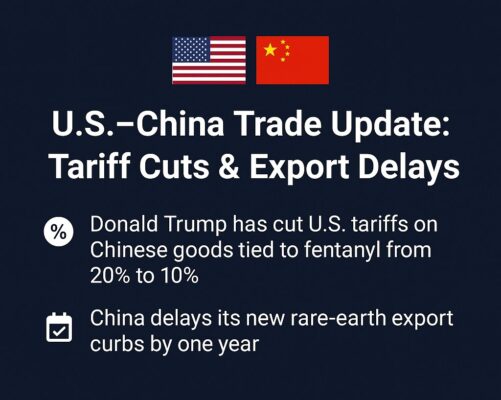
Recent diplomacy between the U.S. and China has yielded a surprising shift in the global trade balance. On one side, Donald Trump announced a reduction of the U.S. “fentanyl” tariff on Chinese goods from 20% to 10%, following high-level talks with Chinese President Xi Jinping.
On the other side, China agreed to delay its planned export curbs on rare-earth elements by one year, providing some relief to international supply chains.
Here’s a breakdown of the key elements, why they matter and what businesses should be watching.
What Changed?
Tariff Adjustment:
The U.S. cut its fentanyl-linked tariff on Chinese imports from 20% to 10%, effective immediately. Trump cited China’s commitments to restrict fentanyl precursor flows as a catalyst for the reduction.
Rare-Earth Export Delay:
China announced a one-year delay in implementing the latest round of export controls on rare earths and magnets. The pause stems from the recent meeting between Trump and Xi and is framed as a tactical easing rather than a full rollback.
Why These Moves Matter
For Supply Chains:
China dominates the processing of rare earths and magnets, critical for EVs, electronics, aerospace, and defense. The export-control delay gives global manufacturers a breathing space and avoids immediate disruptions.
For Trade Relations:
The tariff reduction and export-curb pause signal a potential shift toward de-escalation in the U.S.–China trade war. Both sides seem willing to use “carrots” in addition to “sticks.”
For Businesses Investing Globally:
-
Chinese exports to the U.S. may become more accessible in the short term due to the lower tariff.
-
Global manufacturers relying on Chinese rare earths gain a year’s cushion to adapt or diversify supply.
-
But the underlying strategic risks remain this may be a tactical truce rather than a long-term agreement.
What Companies Should Do
1. Re-evaluate sourcing strategies
If you rely on Chinese materials especially rare earths use the next year to audit alternatives, contractual protections, and contingency plans.
2. Review pricing and supply-chain assumptions
A 10% tariff instead of 20% means a lower cost base for some Chinese-sourced goods. Yet any complacency could be risky if tensions flare up again.
3. Monitor regulatory shifts closely
Export controls and licensing rules related to rare earths are still in flux. Staying ahead of technical, licensing or geopolitical changes is essential.
4. Consider long-term risk management
These developments don’t remove structural dependency on China. Companies should build resilience — whether via diversified suppliers, strategic inventory, or forward contracts.
Final Take
This latest episode marks a temporary easing in one of the world’s most complex trade relationships. While the tariff reduction and rare-earth delay ease immediate pressure, the strategic competition between the two superpowers remains intense.
For businesses engaged in global trade, procurement, and manufacturing, the takeaway is clear: use this window wisely. Don’t assume stability act strategically.
